Nora is a historian of modern East Asia, specializing in the period from 1600 to 2000. Her research examines the social interactions among diverse communities in the Qing Empire, the Republic of China, and the People’s Republic of China, with particular attention to the ways power and identity shaped social and economic development. She also engages with broader questions on the roots of inequality and the processes of modernization, and she conducts her research across nine languages.
She is a permanent research and teaching faculty at Department of History, Lecturer/Assistant Professor in Modern East Asia History, University College London. She is also member of the European Research Council funded GloCoBank project at the University of Oxford, which explores the global history of banking and finance. Nora is leading publications on East Asia’s banking and correspondent networks, with forthcoming six outputs in the form of book chapters and journal articles. In addition to this, she investigates the metabolic intersection of global trade and material culture, dietetics, and imperial governance.
Her current projects
Material culture, medicine, and dietetics of Qing, Republican, and contemporary China
Legal pluralism and borderland governance in the Qing Empire
Origins of East Asia’s payment systems and international trade
Environmental, political, and economic history of Jiangbei
Major Publications and Forthcoming
"Power and Identity in the Qing Empire: A Study of Manchu and Han Elite Material Culture Through Confiscation Inventories" Journal of Asian Studies 2026. 02.
"Dress, Power, and Identity in the Qing Empire, An Investigation of Dress Ownership Found in the Confiscation Inventories, " Central Asiatic Journal 2026.
"Disciplining the State: Confiscation and Strategic Governance in Late Imperial Qing China," with Xiaooyun Tang revision to Past and Present.
"Food and Dietetics" in Cambridge History of Medicine.
Book Projects
Living the Qing Way (Cornell University Press, in prep.)
An exploration of Qing elite identity through material culture and confiscation inventories. By analyzing material culture, it challenges "Han assimilation" theories, revealing a distinct Manchu identity alongside a hybrid "Qing culture" shared by the high-ranking elite.
Encounters: The Qing Empire in 50 Objects (Routledge, contracted)
A comprehensive history of the Qing Dynasty told through fifty pivotal objects. Spanning the entire imperial period, this work rewrites Qing history by examining the intersection of power, emotion, and daily life across genders and social strata.
The Manchu State in Its Own Words (UCL Press, in prep.)
The first Manchu textbook for English speakers to teach entirely in original script. Utilizing archival institutional documents, it serves as both a linguistic primer and a primary source reader for early modern empire-building.
Language Training A native speaker of Chinese, Nora's reading knowledge of Japanese was developed through an intensive language course provided at Amherst College with Prof. Wako Tawa (2015) and further refined at the LSE (2018, 2019). She has studied Manchu continuously for six years under Dr. Lars Laamann at SOAS and further deepened her expertise through studying with Prof. He Bian in 2021 and with Prof. Zhang Li, who worked at the First Historical Archive of China, Manchu section, for 40 years. She developed her reading competence in Classical Tibetan at SOAS (2019–2021), studying with Charles Manson, subject librarian for Tibetan & Himalayan Studies at the Bodleian Library, University of Oxford, and holder of an MTS from Harvard Divinity School in Tibetan Buddhism. She has additionally acquired training in Arabic (Oxford, 2023–2024), classic Mongolian (SOAS, 2023-2024), and Malay (SOAS 2024–2025). She is currently learning other Central Asian languages by taking training courses provided by the University of Kansas (2025-2027).
In European languages, she holds C1 reading proficiency in German, developed through study at Mount Holyoke College (2013–2015) and the University of Mannheim (2016), with additional training in Medieval German under Prof. Oliver Volckart at LSE (2017). She reads Latin (MHC 2013). She took the intensive Russian language course at LSE during COVID-19 pandemic (2021–2022).
Digital Skills STATA (2014-2022), R (LSE 2020-2022), Python (LSE 2020-2022), GIS (LSE 2020-2022), Large Language Model (UCL, Physics 2025-2027).
Nora’s training began with a commitment to reading Eurasia’s primary sources, seeing the past in its own words. Guided by Jonathan Lipman’s advice to “learn all the languages” and Joseph Fletcher’s vision of interregional connection, she treats language as the primary gateway into unfamiliar worlds. In her research, she bridges the gap between philology and programming, treating them as parallel practices with their own internal logics. Whether through close textual reading or computational tools, she studies large-scale historical patterns while remaining fiercely attentive to the smallest detail.
Beyond the Archives
Nora enjoys both the artistry of music and the precision of the bow. A pianist of twenty years and a violinist of six, she formed a rock band in high school (piano, drums, and guitar) and later joined violin and African drumming ensembles at Mount Holyoke. Her musical journey spans performing Gahu and Ewe-rooted dance from Ghana and Togo to studying the Arabic oud, drawn to its microtonal scales unseen in Western or Chinese traditions.
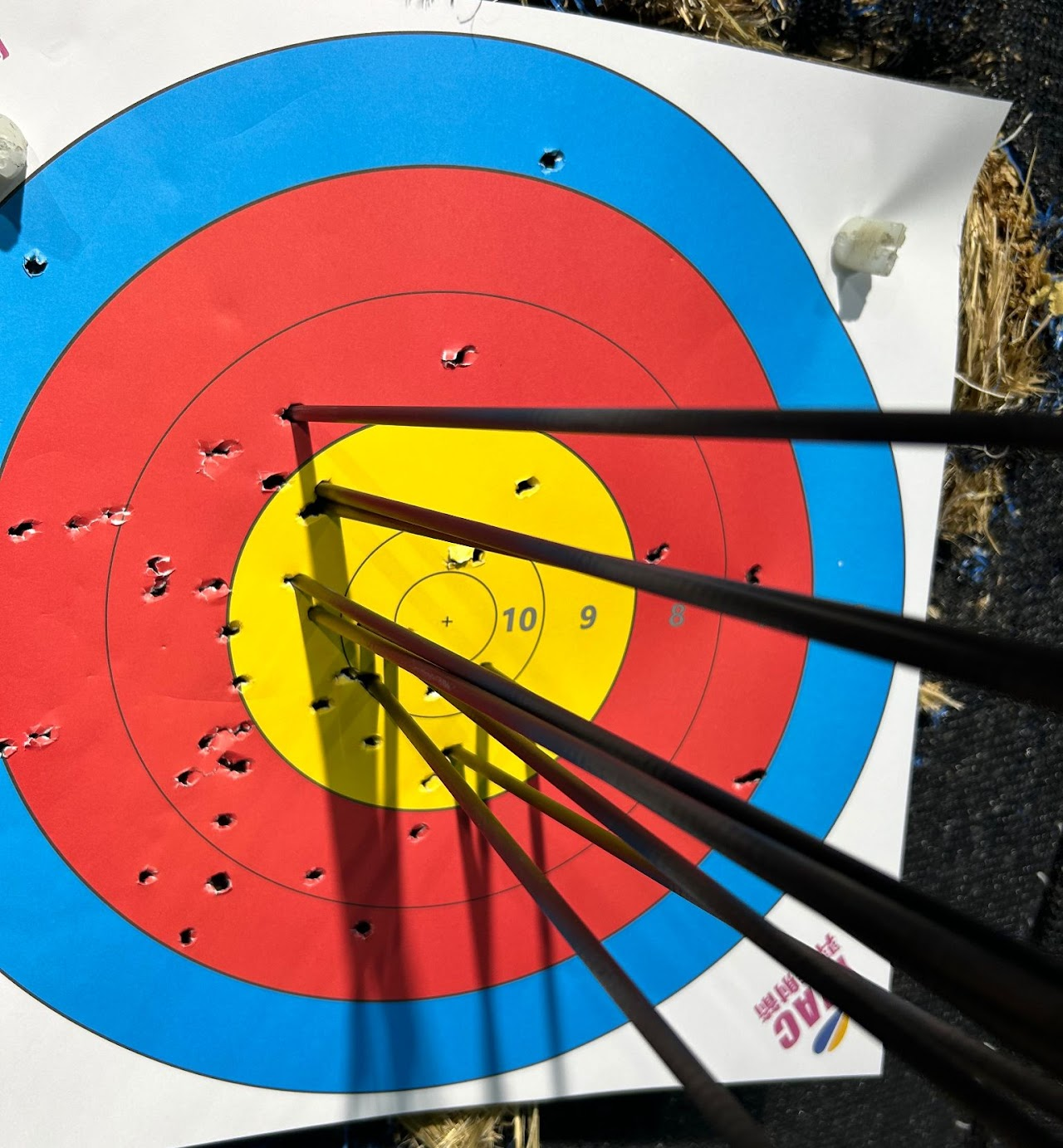
This same focus carries over to the archery range. As a Purple Star modern archer with a scoring record of 575/600 (an average of 9.58 rings per arrow), Nora practices both modern and Qing-style archery. She strives for the "Master Archer" standard—where every release is a disciplined strike to the heart of the target.
Mount Holyoke Violin ensemble (2017)